
Choosing a kitchen sink is a major part of kitchen renovation. From traditional top-mount sinks to newer, trendier units like the low divider sink, consider which type of sink suits your kitchen and your personality the best.
01 Top-Mount, Drop-In, or Self-Rimming Sink
:max_bytes(150000):strip_icc():format(webp)/GettyImages-663753784-5a85d07a3de4230037e6695b.jpg)
The most common type of kitchen sink, the top-mount or drop-in, installs from above. Based on a template provided by the sink manufacturer, a hole is cut into the counter material and the sink is inserted from above. All of the sink’s weight is carried by the rim. Then the rim of the sink is caulked to the counter with silicone. Because the sink edge creates a rim, these sinks are sometimes called rimmed or self-rimming sinks.
Pros
Drop-in sinks are a do-it-yourselfer’s dream. No special skills are needed for installation. Quartz and slab stone countertops are virtually impossible for a homeowner to cut. But most do-it-yourselfers can make sink cut-outs in laminate and even solid surface materials.
Cons
The sink’s rim prevents you from sweeping water and debris from the counter straight into the sink. Also, the rim adds yet another part of the sink that needs to be cleaned.
02 Undermount Sink
:max_bytes(150000):strip_icc():format(webp)/GettyImages-174841379-5a85d100ba61770036d9f06c.jpg)
Undermount sinks are the opposite of top-mount sinks, as the sink is attached to the bottom of the counter with special clips.
Pros
You will love undermount sinks the first time you sweep countertop water and crumbs straight into the sink with a sponge. These sinks have no rim to get in the way, making clean up a charm.
Cons
Though gunk does not build up on top, it will collect under the counter, where the sink and counter meet.
03 Double Basin/Bowl Sink
The most popular type of kitchen sink basin arrangement, the dual basins allow for washing on one side and rinsing or drying on the other side.
Pros
Truly multi-purpose and highly flexible, double basin sinks have all sink operations covered: washing, rinsing, and draining. It is hard to go wrong with a good double basin sink.
Cons
Either side can be too small to accommodate large pots, baking pans, or casseroles.
04 Single Basin/Bowl Sink
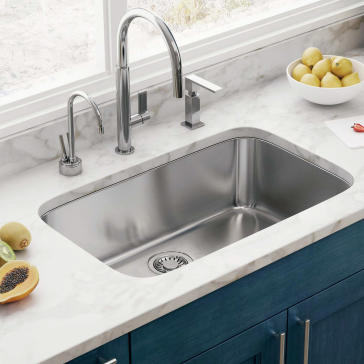
Single basin is a general category of kitchen sinks, which can include both farmhouse (apron) sinks and in-counter sinks. This type of sink has no divided basin.
Pros
The single basin is large enough to wash big items, especially valuable for houses with many people and busy cooking operations.
Cons
Be prepared to have a drying area on the side of the sink, as single basin sinks have no room for this. Unless in the form of a large capacity farmhouse or apron sink, single basins are less popular due to their inflexibility and small size.
05 Farmhouse or Apron Sink
:max_bytes(150000):strip_icc():format(webp)/FarmhouseorApronKitchenSink-5a763884eb97de0037f11592.jpg)
Farmhouse, or apron, sinks are large single basin sinks distinguished by their front wall, which forms both the front of the sink and the front of the counter. The most popular type of installation is with the sink level and integrated in the counters. However, apron sinks are sometimes installed “country style”: on top of a cabinet or on a freestanding table (fixed against the wall) and not surrounded by counters.
Pros
These generously sized sinks allow for big casserole and baking pans. Because there is less room between the sink and the edge of the counter, the person using the sink can move in a little bit closer to the sink, avoiding fatigue. Those who suffer from lower back pain will especially enjoy being able to stand up straighter at the sink.
Cons
Apron sinks are prone to dripping, as there is only a narrow barrier between the sink and the floor.
06 Drainboard Sink
:max_bytes(150000):strip_icc():format(webp)/DrainboardKitchenSink-5a762bbceb97de0037ef6fec.jpg)
Drainboard sinks combine a small basin on one side with a counter-level drainboard on the other side.
Pros
These types of sinks are great in galley kitchens or any limited space. Because the drainboard portion has a lip around it, it traps water and quickly drains it back to the sink.
Cons
Basins tend to be small in drainboard sinks. So if you love to cook and entertain lots of people, this sink may not be for you.
07 Low Divider Double Basin Sink
:max_bytes(150000):strip_icc():format(webp)/Low-DivideKitchenSink-5a763707119fa8003735e84a.jpg)
A low divider kitchen sink is a double basin sink, but instead of the divider rising to the level of the top of the sink, it is only half of that height.
Pros
Low divider sinks are a perfect combination of single basin and double basin sinks. When you fill one side low with water, it works as a double basin sink. But if you need extra room for big pans, simply keep filling higher so that the water overflows the divider.
Cons
Since not many manufacturers offer low divider sinks, prices tend to be higher than for other types, such as single basin, double basin, and even farmhouse sinks.
08 Island, Bar, or Prep Sink

Considerably smaller than primary kitchen sinks, bar (or prep) sinks are used either for bartending operations or for supplementary food preparation. Bar/prep sinks are always single basin and are usually no more than about 15 inches square or diameter (round).
Pros
If you have the space, a second sink is always welcomed. Install this sink in your kitchen island or at the far end of your main countertop.
Cons
Bar/prep sinks have few downsides, due to the fact that they are only supplementary sinks. Perhaps the most significant downside would be that some homeowners install these sinks with good intentions, yet rarely end up using them.
09 Integrated Sink
:max_bytes(150000):strip_icc():format(webp)/CorianIntegratedKitchenSink-5a79c545c6733500374dc276.JPG)
Integrated (or integral) sinks are produced by solid surface countertop manufacturers such as DuPont for its Corian line and Samsung for its Staron line. Integrated sinks are made of the same material as the counter and are fused in place at the fabricator’s shop.
Pros
With integrated sinks, one notable downside of top-mount sinks, the obtrusive rim, is eliminated. Also, the under counter seam (prone to collecting debris and mold) found on undermount sinks is eliminated with integrated sinks. The counter flows seamlessly into the sink.
Cons
Integrated sinks, common in bathrooms, are more difficult to find in the kitchen realm. These are custom order items and, as a result, are rather expensive. Also, if the sink is damaged, it cannot simply be removed and replaced: it must be repaired.
10 Corner Sink

A kitchen corner sink has double basins which are set at right angles to each other.
Pros
Some corner sinks are spaced wide enough to have a built-in drying area in the center section. Corner sinks cleverly make use of notorious space-wasters: counter corners.
Cons
When you can find them, corner sinks are expensive. Also, these sinks require custom cuts in the counters. Since most kitchen counters are seamed at the corners, these sinks are forced to bridge this seam, reducing the structural strength of the countertop in that area.
 ylthardwareandelectrical.home.blog